Learn How an English Professor Shapes the First-Year Experience at Pacific University
Across the USA, colleges and universities are rethinking how they support students during the earliest and most vulnerable stage of their academic lives. Few stories from recent higher education news illustrate this shift as clearly as the one unfolding at University of the Pacific in Stockton, California. There, Jeffrey Hole, a widely respected English professor and director of the First-Year Experience program, has moved his office—and his home—directly into the heart of the first-year residential community.
Hole currently serves as the inaugural Professor-in-Residence in Grace Covell Hall, Pacific’s first-year residence hall, where he pilots a program designed to blur the line between classroom learning and daily student life. Whether he is unpacking boxes in his new office, greeting students by name on their way to class, or leading a weekend hike through nearby trails, his approach reflects a simple but powerful idea: students succeed when they feel known, supported, and connected from day one.
For prospective students and families researching universities, the First-Year Experience at Pacific University offers a concrete example of what meaningful student support can look like. Explore the First-Year Experience program in detail to see how its structure, travel opportunities, and residential initiatives could fit your own college plans.
Why the First-Year Experience Matters for Long-Term College Success
The first year of college is more than an introduction to coursework. It is a period of intense personal change, and research consistently links a student’s early experience to outcomes such as retention, academic performance, and eventual career readiness. Hole frames the stakes in practical terms. In his view, this is one of the most consequential transitions a person will experience in a lifetime, and students who learn to access resources and navigate that transition successfully are better prepared for every subsequent milestone—including their first job after graduation.
That philosophy shapes how Pacific built its First-Year Experience program, now in its second year. Rather than treating the first year as a series of one-off orientation events, the program operates on four deliberate pillars: hands-on learning, a sense of belonging and community, career readiness, and global perspective. Each pillar is designed to give new students tools they can return to throughout college and long after they leave campus.
Professor-in-Residence: A New Model for Faculty and Student Connection
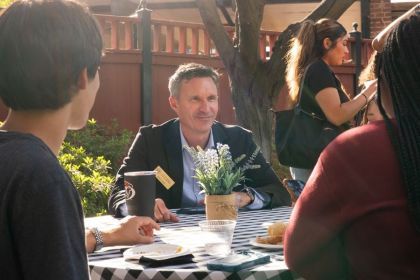
The Professor-in-Residence program puts a faculty member’s daily presence where students need it most: where they live. By residing in the first-year residence hall, Hole does what few professors at American universities have the structure to do. He eats meals with students at the Don and Karen DeRosa University Center, attends musical performances and athletic events, and organizes off-campus excursions such as group hikes—activities that suit him well as an avid hiker and camper.
The impact of this proximity is visible in small moments. Students walking past his office are greeted by name. Conversations start easily. Hole describes his approach as humanistic: when professors show genuine interest in what students are doing, students respond with visible enthusiasm. In his view, students are learning to tell their own stories, and the First-Year Experience gives them a space to practice doing exactly that.
For an English professor, that framing comes naturally. The skills at the core of literary study—careful listening, empathy, narrative, and clear communication—are the same skills that help a new student find belonging on a large campus. Hole’s work demonstrates how the humanities contribute to student success in ways that extend far beyond a single course.
The Four Pillars of Pacific University’s First-Year Experience
Understanding the program’s structure helps families evaluate whether a university’s support system is built on substance or slogans. Pacific’s model rests on four commitments, each with tangible programming behind it.
Hands-On Learning
New students learn by doing. From off-campus excursions that introduce them to their new region to experiential components woven into first-year programming, the program treats the surrounding community as an extension of the classroom.
Belonging and Community
Belonging does not happen by accident. Shared meals, residence hall events, group hikes, performances, and athletic events give students repeated, low-pressure opportunities to form friendships and to see faculty as approachable people rather than distant authorities.
Career Readiness
Career preparation begins in year one, not senior year. By teaching students how to find and use campus resources early, the program builds habits—seeking mentors, asking questions, exploring opportunities—that translate directly into internship searches and first-job success.
Global Perspective
Pacific encourages the idea that global awareness should start immediately, not after two years of coursework. The clearest example is the program’s international travel option, described below.
Study Abroad That Starts in the First Semester
One of the most distinctive features of the First-Year Experience is its global component. Students can apply for the First-Year Experience Abroad during their very first semester on campus. Selected students then travel alongside classmates and Pacific faculty, which means their first international experience happens with a built-in support network rather than alone.
Upcoming destinations include El Salvador and a combined Spain and Morocco itinerary planned for 2027. The program builds on a successful precedent: a group of first-year students traveled to Chile over winter break in 2025, exploring historic sites and experiencing a new culture together.
Participants describe the effect as lasting. Erick Ramirez Jimenez, a member of the class of 2029, credited the trip to Chile with helping him build strong connections with professors and fellow students while bringing a more global perspective back to campus. He also noted that Hole served as an early point of contact for the program, offering encouragement to aim high and pursue new opportunities. Review the application details for First-Year Experience Abroad if early international travel is a priority in your college search.
Building Confidence That Carries Beyond Graduation
Ask Hole what he ultimately wants students to take from the program, and the answer is not a grade or a credit hour. It is confidence. His goal is for students to trust that they can find their way through the challenges of the first year, and to know where to turn when they feel lost later—during a difficult course, a competitive internship search, or the uncertainties that follow commencement.
That outcome matters for families weighing the cost of a degree. A university that teaches students how to navigate institutions, build relationships with faculty, and recover from setbacks is delivering a skill set employers consistently rank among the most valuable. The first year, in this model, is not a buffer zone. It is the foundation. Schedule a campus visit to walk the residence halls, meet faculty members, and see this support system firsthand before making a decision.
Questions to Ask When Evaluating First-Year Programs at Universities in the USA
Pacific’s approach offers a useful benchmark for any student comparing colleges in the USA. As you research options, consider asking admissions offices and current students the following questions:
- Is there a structured first-year program? Look for defined pillars or learning outcomes, not just a single orientation week.
- Do faculty engage students outside the classroom? Initiatives like Professor-in-Residence signal an institutional commitment to student-centered teaching.
- Can students study abroad in year one? Early travel options with faculty accompaniment remove common barriers such as cost anxiety and social isolation.
- How does the university build community? Shared meals, excursions, and residential programming are more effective than passive mixers.
- When does career preparation begin? Strong programs introduce students to career services and mentorship during the first semester.
Asking these questions early helps families distinguish between universities that market student success and universities that engineer it. Request more information from the admissions team to get specific answers about how a school supports its newest students.
A Story Worth Following in Higher Education News
Stories like the one at Pacific University matter because they show what happens when a university invests in relationships rather than just infrastructure. An English professor living among first-year students, greeting them by name, and leading them up a local trail or onto a plane to Chile is a visible, measurable expression of institutional values.
For students preparing to begin their college journey, the lesson is equally clear: the environment you choose for your first year will shape how you handle every transition that follows. Seek out communities where professors know your name, where belonging is built deliberately, and where global opportunities start early. Explore related university news and campus stories to keep following how programs like this evolve—or share your own first-year experiences in the comments below to help other students navigating the same transition.