
Build Community Connections Through Volunteering at University of the Pacific’s Day of Service
The Impact of the University of the Pacific Day of Service on Student Engagement
When students arrive on a college campus for the first time, their immediate focus often centers on academics, navigating new living arrangements, and finding their social footing. However, higher education is increasingly recognizing that true student engagement extends far beyond the classroom walls. At University of the Pacific, this philosophy is put into direct action through the annual Day of Service, an event that actively integrates new and returning students into the fabric of San Joaquin County. By prioritizing volunteering and community connections, the university sets a clear expectation that students are not just temporary residents, but active contributors to their local environment.
This massive coordinated effort brings together hundreds of participants to address localized needs, proving that institutions of higher learning can serve as vital catalysts for regional development. For prospective students and families evaluating colleges, the presence of a robust, well-attended Day of Service signals a healthy campus culture where student engagement is taken seriously and practiced at scale. Schedule a free consultation to learn more about student engagement opportunities.
How Volunteering Fosters Authentic Community Connections
Volunteering requires individuals to step outside their comfort zones and interact with diverse groups of people, including local residents, nonprofit leaders, and peers from entirely different academic backgrounds. Unlike structured classroom discussions, service work demands active, hands-on collaboration. When students work side-by-side to sort donations or clear invasive plants, they develop a shared sense of purpose that accelerates relationship building.
The University of the Pacific Day of Service specifically targets this dynamic by partnering with a wide array of local organizations. Rather than keeping students confined to the campus perimeter, the event pushes them into the heart of Stockton and the broader San Joaquin County. This geographical integration is essential for breaking down the traditional “campus bubble” that can isolate universities from their surrounding towns. By seeing the immediate impact of their labor in local parks, shelters, and food banks, students learn to view the community as an extension of their educational environment. This perspective shift is a fundamental component of deep, lasting community connections.
First-Hand Experiences in Student Engagement
The true value of a Day of Service is best understood through the experiences of the participants. For first-year students like Jacqueline Celias, the event provides an accessible entry point into college life that does not rely solely on academic interests or residential proximity. Celias, a biological sciences major, noted that while the work at the Emergency Food Bank was physically demanding, the fast-paced environment and the necessity of keeping up with her peers created an immediate, bonding camaraderie.
Her experience highlights a crucial aspect of student engagement: it does not always have to be quiet or sedentary. The act of packing nearly 800 bags of nonperishable items and serving roughly 400 individuals in a distribution line requires coordination, stamina, and teamwork. Students who might struggle to introduce themselves in a crowded lecture hall often find it much easier to strike up a conversation while sharing a physically demanding task. These shared struggles and triumphs lay the groundwork for friendships that can sustain students throughout their college careers, proving that volunteering is a highly effective social lubricant.
Strategic Partnerships That Drive the Day of Service
A successful Day of Service does not happen by accident. It requires months of logistical planning, clear communication, and, most importantly, strong partnerships with community organizations. University of the Pacific collaborated with 16 distinct community organizations for its recent event. This deliberate decentralization of labor ensures that volunteer hours are distributed efficiently to where they are needed most, rather than overwhelming a single site or performing make-work tasks.
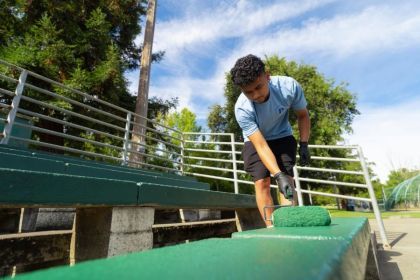
The specific sites chosen for the Day of Service reflect a holistic approach to community well-being. Volunteers cared for animals at the Stockton Animal Shelter, addressing local animal welfare needs. Environmental sustainability was tackled head-on at Stockton’s Sandman Park, where students planted trees to improve local green infrastructure. Meanwhile, the Emergency Food Bank assignment addressed immediate food insecurity, a pressing issue in many American communities today. By diversifying the types of organizations served, the university ensures that students with varying interests—whether they lean toward veterinary science, environmental studies, or public health—can find a service site that resonates with their personal and professional goals. Have questions? Write to us to find out how you can participate in local service projects.
The Role of University Infrastructure in Sustaining Volunteering
While a single Day of Service is impactful, its true purpose is to act as a gateway to sustained involvement. As Jessica Serrano-Sotelo, a Pacific Volunteer Center Specialist, articulated, the goal is for students to see themselves as ongoing partners and leaders in creating positive change. This long-term vision requires dedicated institutional infrastructure.
The Pacific Volunteer Center serves as the central hub for this ongoing student engagement. By employing specialists who coordinate with local nonprofits, manage logistics, and train student leaders, the university ensures that the momentum generated by the Day of Service does not dissipate when the event ends. The center provides a clear, organized pathway for students who want to make volunteering a regular part of their weekly schedule. This infrastructure is critical; without it, even the most enthusiastic students may struggle to find consistent opportunities, leading to a drop-off in community connections as the academic semester becomes more demanding. Explore our related articles for further reading on university volunteer programs.
National Recognition for Community Connections in USA News
The commitment to integrating community connections into the core mission of a university does not go unnoticed. Earlier this year, University of the Pacific received the Carnegie Community Engagement Classification, a highly respected national recognition. This classification is not simply a marketing tool; it is a rigorous assessment of an institution’s curriculum, culture, and practices to determine how deeply community engagement is embedded into its identity.
When higher education institutions earn this type of distinction, it frequently garners attention in USA news and regional media outlets. This coverage is important because it shifts the national conversation about higher education away from purely metrics-based rankings—such as standardized test scores or acceptance rates—and toward the tangible social impact a campus has on its surrounding region. For prospective students tracking USA news for college information, seeing a university highlighted for its community engagement provides a more nuanced understanding of the school’s values. It indicates that the institution prepares students not just to enter the workforce, but to be responsible, active citizens who understand the social fabric of their communities.
Why Prospective Students Should Prioritize Volunteering Opportunities
High school students and their families often prioritize campus facilities, faculty-to-student ratios, and major offerings when building their college lists. While these factors are undeniably important, the availability and quality of volunteering programs should hold equal weight in the decision-making process. Engaging in a Day of Service or ongoing community connections during college yields practical benefits that directly impact a student’s post-graduate success.
First, volunteering builds a robust professional network outside of traditional academic circles. The nonprofit leaders, community organizers, and local government officials that students interact with during service projects can become valuable mentors, references, or even future employers. Second, consistent volunteering develops soft skills that are highly sought after in the modern job market. Time management, empathy, cross-cultural communication, and the ability to lead diverse groups of people are all skills honed on the ground at places like the Stockton Animal Shelter or Sandman Park.
Furthermore, students who actively engage in their communities report higher levels of mental well-being and a stronger sense of belonging. College can be an isolating experience, but grounding oneself in local community connections provides a stabilizing force. It reminds students that they are part of a larger ecosystem that relies on their active participation. Submit your application today to become part of a university that values community impact.
Make Community Connections a Core Part of Your College Experience
The University of the Pacific’s Day of Service demonstrates that large-scale volunteering is entirely feasible when an institution commits the necessary resources and organizational willpower. By sending over 600 students, faculty, staff, and alumni into San Joaquin County to partner with 16 local organizations, the university has created a replicable model for how higher education can effectively bridge the gap between campus life and local community needs.
For current students, the lesson is clear: take advantage of these organized opportunities. Step out of the dorm, sign up for a shift at the food bank, and allow yourself to be challenged by new environments. For prospective students, let the presence of events like the Day of Service serve as a benchmark for evaluating a college’s dedication to student engagement. A university that actively pushes you to build community connections is a university that is invested in your holistic development as a human being, not just your academic output. Share your experiences in the comments below about how volunteering has shaped your educational path.