
UNE Marine Sciences Students Lead Annual Kelp Harvest to Advance Sustainable Aquaculture
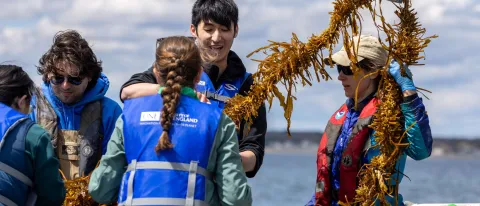
As climate change reshapes coastal ecosystems and traditional fisheries face unprecedented depletion, the demand for resilient and environmentally friendly marine industries is growing rapidly. In response to this shift, the University of New England (UNE) is equipping the next generation of scientists and entrepreneurs with practical, on-the-water experience. Recently, UNE students conducted their annual kelp harvest, pulling nearly 1,000 pounds of seaweed from the cold spring waters of Saco Bay. This hands-on operation highlights the critical intersection of marine sciences, sustainable aquaculture, and workforce development, offering a blueprint for how universities can prepare students for the emerging blue economy.
Examine the Role of Kelp in Maine’s Changing Coastal Economy
Maine’s coastal economy has historically relied on wild-caught fisheries, but warming waters and shifting ecosystems are forcing a reevaluation of how marine resources are managed. As sustainable aquaculture frequently dominates USA news surrounding climate resilience, kelp farming has emerged as a highly viable alternative. Kelp requires no freshwater, no arable land, and no fertilizers to grow. Instead, it thrives on naturally occurring nutrients in the ocean, making it one of the most sustainable forms of food production available today.
Beyond its value as a food source, kelp plays a crucial role in environmental mitigation. As it grows, kelp absorbs nitrogen and carbon dioxide from the surrounding water, effectively reducing ocean acidification and improving local water quality. Furthermore, kelp forests provide essential habitat for a variety of marine species, supporting broader ecosystem health. By integrating kelp harvest initiatives into their academic programs, UNE students are not just studying these environmental benefits in a textbook—they are actively participating in the restoration and economic revitalization of Maine’s working waterfront.
Explore UNE’s marine sciences programs to see how you can participate in future harvests and fieldwork.
Execute the Mechanics of the UNE Kelp Harvest
Cultivating Sugar Kelp and Winged Kelp
Operating a sea farm requires precise timing, physical endurance, and a deep understanding of marine biology. On a gray, overcast morning in early May, UNE students and professional staff navigated to the University’s sea farm located northeast of Ram Island, just off the Biddeford Campus. The primary objective of this season’s kelp harvest was twofold: to harvest traditional sugar kelp and to successfully cultivate and harvest Alaria esculenta, commonly known as winged kelp. This marked the first time winged kelp was grown at UNE’s sea farm, representing a significant milestone in the institution’s aquaculture research.
Introducing a new species like winged kelp to a sea farm is no small feat. It requires careful monitoring of growth rates, susceptibility to local pests, and overall yield compared to established crops. The successful harvest of Alaria esculenta demonstrates the adaptability of UNE’s aquaculture systems and opens the door for future market diversification, as different kelp species offer varying flavor profiles and nutritional benefits for culinary applications.
From Sea Farm to Research Vessel
The physical process of harvesting kelp is labor-intensive and requires seamless teamwork. Students worked collaboratively to haul thick, heavy bands of kelp from the ocean floor onto the deck of a UNE research vessel. In a single morning, the team managed to extract approximately 1,000 pounds of wet kelp. Once brought ashore, the seaweed undergoes a rigorous processing phase: it must be promptly cleaned, dried, and prepared for consumption. The 1,000 pounds of raw harvest will ultimately yield roughly 100 pounds of usable, dried kelp, illustrating the significant water weight inherent in marine macroalgae.
For students like Julianne Manlove, a first-year student double-majoring in Marine Sciences and Biochemistry, this hands-on environment is invaluable. “This was my first time getting to see a sea farm in person, and I was really surprised and amazed by the amount of kelp that was able to grow,” Manlove noted. The practical experience of piloting vessels and handling heavy aquaculture equipment directly translated into a summer job at a local boatyard, proving that fieldwork cultivates highly transferable workforce skills.
Schedule a free consultation to learn more about interdisciplinary degree options in marine and environmental sciences.
Bridge Marine Sciences and Business with the SeaMade Kelp Bar
An Interdisciplinary Student-Run Enterprise
One of the most distinctive aspects of the UNE kelp harvest is its direct connection to a student-led business venture known as the SeaMade Kelp Bar project. SeaMade originated as an independent company founded by Tara Treichel and Mark Dvorozniak, who donated the enterprise to UNE in 2024 to serve as a hands-on educational initiative. Today, it operates as a dynamic, interdisciplinary project situated within UNE’s innovation ecosystem on the Biddeford Campus.
The success of the SeaMade bar relies on collaboration across multiple academic departments. Marine sciences students handle the cultivation and harvesting of the kelp. Nutrition students utilize the UNE Teaching Kitchen to formulate recipes that balance the distinct umami flavor of seaweed with appealing complementary ingredients. Business and entrepreneurship students manage the branding, supply chain logistics, financial modeling, and marketing strategies required to bring a physical product to market. This intersection of disciplines ensures that students understand the complete lifecycle of a sustainable product, from the ocean to the consumer’s hands.
Production and Sustainable Sourcing
The 100 pounds of dried kelp resulting from the spring harvest is a critical component of this supply chain. It provides enough raw material to produce approximately 5,000 SeaMade bars. The product formulation focuses heavily on localized, all-natural ingredients, combining the harvested kelp with locally sourced honey and berries. This commitment to local sourcing minimizes the carbon footprint associated with transportation and supports regional agricultural producers, further reinforcing the project’s sustainability credentials.
By managing the production in the Teaching Kitchen, students learn about food safety, nutritional analysis, and scaling recipes from small batches to larger commercial volumes. Matt Duddy, M.S., the kelp farm manager for UNE’s School of Marine and Environmental Programs, emphasized that the true value of the SeaMade project lies in its student-led nature. From installing the aquaculture lines in the winter to designing the packaging in the spring, every step is driven by student effort and academic inquiry.
Submit your application today to join hands-on sustainability initiatives like the SeaMade project.
Assess the Environmental Benefits of Sustainable Aquaculture
The integration of kelp farming into academic curricula serves a dual purpose: it prepares students for future careers while actively contributing to environmental remediation. As Matt Duddy points out, the cultivation of kelp is a rapidly growing industry in Maine, largely because it offers a viable alternative as traditional fisheries become scarce. However, the environmental benefits extend far beyond replacing lost revenue.
Kelp aquaculture is a form of extractive farming. Unlike terrestrial agriculture, which often requires inputs like fertilizers that can run off and degrade water quality, kelp extracts excess nitrogen and phosphorus from the water column. These nutrients frequently enter coastal waters from agricultural runoff and wastewater treatment facilities, leading to harmful algal blooms and hypoxic dead zones. By sequestering these nutrients, kelp farms act as natural water purification systems.
Additionally, kelp provides structural habitat in areas where the ocean floor might otherwise be barren. The floating cultivation lines create a three-dimensional environment that attracts juvenile fish, crabs, and other invertebrates, effectively acting as a temporary reef. As UNE students study these ecological interactions, they are gathering valuable data that can inform future coastal management policies and sustainable aquaculture practices on a national scale.
Build Workforce Skills for the Blue Economy
The concept of the “blue economy” refers to the sustainable use of ocean resources for economic growth, improved livelihoods, and jobs, while preserving the health of ocean ecosystems. For students pursuing degrees in marine sciences, understanding the blue economy is essential. The annual kelp harvest at UNE provides a direct pipeline into this economy, offering tangible workforce training that cannot be replicated in a traditional classroom setting.
Students involved in the harvest learn how to operate small research vessels, tie specialized maritime knots, handle heavy wet lines, and process biological materials efficiently. They also learn the logistical complexities of operating a marine-based business, including navigating regulatory requirements, managing seasonal workflows, and adapting to unpredictable weather conditions. These are the exact skills that employers in the aquaculture, marine research, and maritime industries are actively seeking.
“When students participate in the kelp harvest and design of the SeaMade Bar, they are learning tangible skills that can be applied to jobs on the working waterfront in the future,” Duddy stated. This focus on employability ensures that graduates are not only scientifically literate but also operationally capable of leading Maine’s coastal industries into the future.
Have questions about the SeaMade project or aquaculture? Write to us!
Prepare for a Future in Marine Sciences
Experiences like the UNE kelp harvest demonstrate the profound impact of experiential learning in higher education. By stepping out of the lecture hall and onto the deck of a research vessel, students gain a holistic understanding of how sustainable aquaculture functions in the real world. They see firsthand how biological sciences intersect with business, nutrition, and environmental stewardship. Whether a student’s goal is to launch a sustainable food startup, conduct marine ecological research, or manage a commercial aquaculture operation, the foundational skills built on the working waterfront are indispensable.
As the global demand for sustainable food sources and environmental mitigation strategies continues to rise, the innovations being pioneered in Saco Bay will only become more relevant. UNE students are not just passive observers of this shift; they are active participants, pulling in the lines, processing the harvest, and building the businesses that will define the future of our oceans.
Share your experiences with sustainable aquaculture in the comments below.