
Secure Science Internships at Brookhaven National Laboratory Through Adelphi University Physics Programs
Gaining practical laboratory experience is a critical step for any undergraduate aiming to build a successful career in STEM. Recent news from the USA highlights how strategic university partnerships can provide students with unparalleled access to elite research facilities. Adelphi University has established a robust pipeline for its physics students to participate in highly competitive science internships at the Brookhaven National Laboratory. By bridging academic coursework with real-world scientific inquiry, these programs allow students to contribute to meaningful projects while developing essential technical skills.
Submit your application today to start your research journey.
How Adelphi University Connects Physics Students to Brookhaven National Laboratory
Locating valuable research opportunities requires more than just a strong GPA; it demands an institution that actively fosters industry and laboratory partnerships. Adelphi University distinguishes itself by maintaining a formal science partnership with Brookhaven National Laboratory, a premier U.S. Department of Energy facility located on Long Island. The laboratory spans 5,300 acres and houses state-of-the-art centers dedicated to nuclear physics, high-energy physics, environmental science, bioscience, and energy technology. Over its history, the facility has been the site of seven Nobel Prize-winning discoveries and has earned 37 R&D 100 Awards, cementing its status as a global leader in scientific advancement.
For undergraduate students, gaining entry into such a prestigious environment can seem daunting. Adelphi removes this barrier through structured pathways like the Workforce Development & Science Education (WDSE) mini-semester program. This initiative allows students to tour the scientific facilities, observe ongoing research projects, and interact directly with world-class scientists and engineers. By facilitating these early connections, Adelphi ensures that its physics majors are well-positioned to secure summer internships that align with their specific academic interests.
Exploring AI and Computational Imaging in USA Science Internships
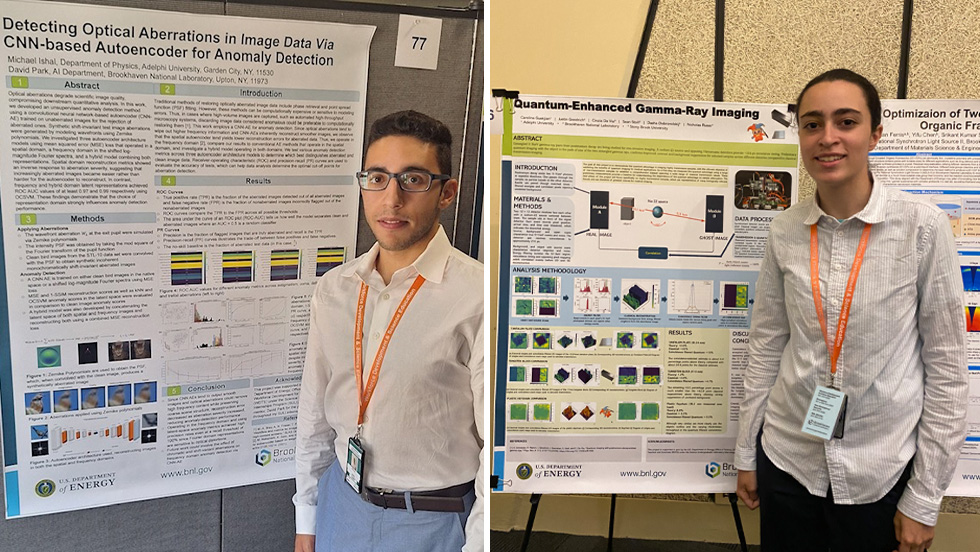
The application of artificial intelligence to physical sciences is accelerating rapidly, and undergraduate internships are increasingly reflecting this trend. Michael Ishal, a senior physics major at Adelphi University, recently completed a summer internship in Brookhaven’s Computing and Data Sciences department. His work focused on AI and computational imaging, specifically testing neural network-based methods to detect optical aberrations—flaws in lenses or mirrors that distort images.
Ishal’s project built directly upon foundational concepts he learned at Adelphi, including Rayleigh’s criterion, a principle that defines the resolution limit of an optical system. Under the mentorship of Brookhaven scientist Dr. David Park, Ishal applied machine learning algorithms to determine whether image degradation was caused by these specific optical imperfections. This type of research has significant implications for improving automated imaging systems, telescopes, and microscopic analysis tools used across various scientific disciplines.
Building on Undergraduate Research Foundations
The transition from classroom learning to independent laboratory research is often the most challenging aspect of a science degree. Ishal attributes his success at Brookhaven to the research foundation he built at Adelphi. By engaging in early research opportunities and working closely with faculty members like Dr. Kevin Liang, Ishal developed the critical thinking skills necessary to evaluate complex scientific literature and propose viable research methodologies.
His internship experience reinforced the importance of balancing collaboration with independence. While Dr. Park provided guidance, Ishal was responsible for expanding his domain of knowledge through literature searches, writing code, and analyzing datasets. This balance is a hallmark of effective science internships, forcing students to take ownership of their projects while learning how to communicate findings to established experts.
Schedule a free consultation to learn more about our physics programs.
Advancing Medical Imaging Through Quantum Entanglement Research
While computational imaging focuses on correcting visual data, other research at Brookhaven National Laboratory aims to fundamentally redefine how images are captured. Carolina Guekjian, another Adelphi University senior physics major, spent her internship investigating the applications of quantum entanglement in high-resolution imaging. This strange physical phenomenon, where particles become interconnected and the state of one instantly influences the state of another regardless of distance, holds the potential to revolutionize medical imaging.
Guekjian’s research explores how quantum entanglement can produce images at a spectacularly high level of resolution. If successfully integrated into clinical settings, this technology could enable medical professionals to discover and diagnose diseases at their earliest, most treatable stages. The practical implications for patient outcomes are substantial, demonstrating how foundational physics research directly translates to public health advancements.
Gaining Access to World-Class Particle Accelerators
Beyond her specific research project, Guekjian’s internship provided rare access to some of the most advanced scientific machinery in the USA. She observed experiments conducted through the National Synchrotron Light Source II (NSLS-II) Beam Lines, which allow researchers to study materials at nanoscale resolution using ultra-bright light. Additionally, she witnessed the inner workings of the detectors used at the Relativistic Heavy Ion Collider (RHIC) during a transitional period as the laboratory prepared for the construction of the Electron Ion Collider (EIC).
Exposure to these massive, complex facilities provides undergraduate students with a perspective that cannot be replicated in a standard university laboratory. Understanding the scale, engineering requirements, and collaborative effort required to run a national laboratory helps students contextualize their own career goals within the broader landscape of modern science.
Have questions about undergraduate research? Write to us!
The Strategic Value of Undergraduate Science Internships
Participating in high-level internships provides tangible benefits that extend far beyond the laboratory. For students in the USA, the STEM job market remains highly competitive, and employers increasingly expect candidates to possess hands-on experience before they even graduate. Completing an internship at a federally funded research laboratory signals to graduate school admissions committees and future employers that a student possesses both technical competence and professional maturity.
Furthermore, these experiences help students refine their career trajectories. Spending a summer working in computational imaging might lead a student to specialize in data science or machine learning, whereas time spent at a synchrotron facility might inspire a career in accelerator physics or materials science. By testing different environments and methodologies during their undergraduate years, students can make informed decisions about their graduate studies, avoiding costly career pivots later on.
The networking opportunities provided by these internships are equally valuable. Working alongside postdoctoral researchers, principal investigators, and fellow interns from across the country allows students to build a professional network that will support them throughout their careers. Guekjian’s performance was so strong that she was offered the opportunity to extend her internship into the academic year, a testament to the value she provided to her research team and the connections she forged.
Share your own internship experiences in the comments below.
Navigate the Application Process for Competitive Research Positions
Securing a position at a facility like Brookhaven National Laboratory requires proactive planning and strategic networking. The experiences of Adelphi University students highlight several actionable steps aspiring scientists can take to improve their chances of acceptance.
First, engage with faculty members early in your academic career. Both Ishal and Guekjian worked closely with their professors on campus before applying to external internships. Faculty mentors can provide crucial recommendations, identify relevant programs, and sometimes directly introduce students to laboratory contacts.
Second, take advantage of introductory programs and facility tours. Ishal secured his internship by participating in the WDSE mini-semester program. Rather than applying blindly to a highly competitive pool, he used this program to identify a specific researcher whose work aligned with his own interests. When he approached Dr. Park, he was able to speak intelligently about the scientist’s published papers, demonstrating that he had done his homework.
Finally, act decisively when opportunities arise. Upon learning that Dr. Park was accepting interns, Ishal read the relevant publications and sent a detailed email discussing his research the very same night. In the competitive landscape of science internships, timing and demonstrated enthusiasm often make the difference between a rejected application and a life-changing opportunity.
Explore our related articles for further reading on science careers.
Prepare for Your Future in Science Research
The partnership between Adelphi University and Brookhaven National Laboratory represents a highly effective model for undergraduate science education. By integrating classroom theory with practical, cutting-edge research, students graduate with the skills, confidence, and professional networks required to lead in their respective fields. Whether exploring the frontiers of artificial intelligence in imaging or harnessing the bizarre properties of quantum mechanics, these internships prepare the next generation of physicists to tackle the most pressing scientific challenges of our time.