
Review the Cal State San Marcos Student Art Exhibition Hosted by President Neufeldt
How Cal State San Marcos Supports Student Artists Through Unique Campus Events
Creativity plays a fundamental role in higher education, shaping how students interpret the world and their place within it. At Cal State San Marcos, this belief is not just an academic philosophy but an active practice supported by university leadership. The campus provides a robust environment for the arts, with more than 800 students currently majoring or minoring in creative disciplines within the College of Humanities, Arts, Behavioral and Social Sciences. This large cohort requires significant institutional backing, ranging from studio space and specialized equipment to mentorship and public exhibition opportunities.
Building a sustainable career in the arts requires more than just technical skill; it demands practical experience in presenting work to the public and engaging with professional curators. By organizing high-profile campus events, universities can bridge the gap between the classroom and the professional art world. These events allow student artists to test their concepts in a public forum, receive direct feedback, and build their professional portfolios. Explore our related articles for further reading.
The “Forms of Growth” Student Art Exhibition Highlights Botanical Themes
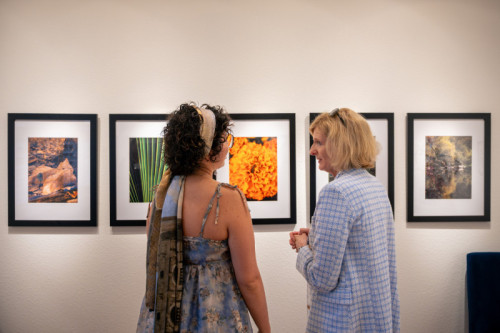
One of the most notable examples of this institutional support is the annual student art exhibition hosted by President Ellen Neufeldt. Now in its fourth year, this recurring event has become a meaningful tradition at Cal State San Marcos. Unlike standard gallery shows, this exhibition takes place at the president’s residence, providing a unique, intimate setting that elevates the student experience and signals high-level administrative endorsement of the arts.
This year’s showcase, titled “Forms of Growth,” centers on botanical themes. The featured student artists use plant life—its intricate forms, varied textures, and complex patterns—as a medium to explore broader personal and social experiences. Rather than simply creating literal representations of flowers or trees, the artists leverage botanical subjects to investigate concepts of identity, consumption, memory, and belonging. The exhibition demonstrates how natural forms can serve as powerful metaphors for human experiences and social structures.
The Role of Curation in Academic Art Spaces
A critical component of this student art exhibition is the involvement of a professional curator. Each iteration of the series has been thoughtfully organized by Sarah Bricke, a professional artist and Cal State San Marcos alumna. Bricke’s continued involvement ensures that the exhibition maintains a high standard of professional presentation. Her role involves selecting the participating student artists, guiding the thematic direction, and helping the students refine their artist statements and spatial arrangement of their work.
For student artists, working with a professional curator provides invaluable insight into the mechanics of the art industry. They learn how to contextualize their individual practices within a broader group narrative. This mentorship dynamic helps demystify the curatorial process, teaching students how to communicate their artistic intentions clearly and effectively. Have questions? Write to us!
Spotlight on the Featured Student Artists at Cal State San Marcos
The strength of the “Forms of Growth” exhibition lies in the diverse approaches taken by the four featured student artists. While they share a common thematic anchor in plant life, their methodologies, materials, and underlying messages vary significantly. This diversity reflects the breadth of the art program at Cal State San Marcos and highlights how a single theme can be interpreted through multiple academic and personal lenses.
Amber Miller: Counteracting Abuse Through Nature and Intimacy
Amber Miller utilizes a combination of sculpture and photography to address heavy, complex themes related to trauma and healing. Her work specifically aims to counteract cultures of abuse by emphasizing intimacy and proximity. Miller draws a direct connection between Mother Nature and the human body, viewing both as manifestations of a shared essence of the soul. Through her artistic practice, she seeks to illustrate alternative ways of being that exist outside of oppressive structures. By aligning the human form with natural elements, her art proposes that nature itself offers frameworks for resilience, connection, and recovery that are inherently resistant to systemic harm.
Charlotte Dumbeck: Critiquing Overconsumption Through Material Reversals
Charlotte Dumbeck’s contribution to the student art exhibition takes a sharply critical look at modern economics. Her art interrogates a global economy that is heavily sustained by overconsumption, investigating the resulting cultural and environmental consequences. Dumbeck achieves this through a technique she terms “material reversals,” which involves creating tensions between organic and inorganic items. By transforming materials—making synthetic objects appear organic, or treating natural materials as if they were industrial—she forces the viewer to confront the consequences of everyday consumption. Her work acts as a visual critique of humanity’s fractured relationship with the natural world, asking viewers to reconsider the lifecycle of the objects they use daily.
Destiny Kirchner: Merging Scientific Observation and Artistic Interpretation
Destiny Kirchner approaches the botanical theme through a highly analytical, almost scientific lens. Her work explores how the physical structures of plant life can dictate the composition of visual art. Kirchner creates plaster molds cast directly from real plants, capturing their exact imprints and preserving minuscule details that are often overlooked by the naked eye. These physical reliefs are displayed alongside traditional, illustrated botanical studies of native California plants. The juxtaposition of the highly accurate plaster casts and the interpretive drawings creates a compelling dialogue between strict scientific observation and subjective artistic interpretation. Her work celebrates the precision of nature while questioning how humans categorize and document the natural world.
Rodas Alonzo: Reclaiming Indigenous Knowledge Through Sculpture
Rodas Alonzo uses sculpture as a method of cultural preservation and reclamation. Her work is deeply tied to reclaiming ancestral Indigenous knowledge, specifically focusing on themes of agriculture, identity, spirituality, gastronomy, and ecology as they relate to Indigenous communities in Guatemala. Alonzo constructs complex sculptural forms using a diverse mix of materials, including plaster, wire, cardboard, leaves, and clay. By allowing organic elements to interact with industrial ones, she visually represents the tensions between the living and the inert. These material choices are highly intentional, tracing ecological systems and connecting them to ancestral teachings regarding sustainable land management. Her art serves as a physical archive of cultural knowledge, asserting the ongoing relevance of Indigenous ecological practices in contemporary discussions about sustainability.
Using Plant Life to Address Social and Personal Narratives
When viewed together, the works of Miller, Dumbeck, Kirchner, and Alonzo demonstrate the versatility of botanical art. Far from being a purely decorative genre, botanical-themed art becomes a potent vehicle for social commentary. Plants are used to discuss the trauma of abuse, the destructive nature of consumerism, the rigor of scientific classification, and the resilience of Indigenous cultures. The “Forms of Growth” exhibition proves that nature can serve as a universal language, allowing student artists to articulate deeply personal and highly political narratives through organic forms. This synthesis of the natural world with human experience is a hallmark of advanced artistic inquiry. Share your experiences in the comments below.
Why Institutional Support Matters for Emerging Creatives
In the broader landscape of USA news, higher education institutions frequently face debates regarding the relevance and funding of humanities and arts programs. Against this backdrop, the active, visible support demonstrated by President Neufeldt is highly significant. When university presidents open their personal residences to host a student art exhibition, it sends a clear message to the campus community and the public: the arts are a central, valued component of the university’s mission.
This type of high-level visibility does more than just make the students feel appreciated; it provides them with a credible, highly publicized platform that can launch their professional careers. The transition from student to professional artist is notoriously difficult, often hindered by a lack of exhibition opportunities and professional networking. By institutionalizing this annual event, Cal State San Marcos directly addresses these industry barriers, giving its students a competitive edge as they enter the creative workforce.
Apply to Cal State San Marcos and Join the Creative Community
For prospective students evaluating art programs, the presence of unique, institutionally backed exhibition opportunities should be a major deciding factor. A strong university art program is defined not just by its facilities, but by the opportunities it provides for students to engage with professional curators, display their work in unconventional spaces, and receive mentorship from established alumni like Sarah Bricke.
Cal State San Marcos continues to demonstrate its commitment to fostering a dynamic, supportive environment for student artists. Whether you are interested in sculpture, photography, drawing, or critical art theory, finding a program that actively promotes your work is essential for your professional development. If you are looking for a university that values creative expression and provides tangible platforms for student success, researching these types of specialized programs is a logical next step. Submit your application today. Take the time to evaluate how different universities support their creative communities, and schedule a free consultation to learn more about finding the right academic fit for your artistic goals.