Navigate the Path to Medical School: Insights from the CSUSM North County Aspiring Medical Professionals Conference
Securing a seat in medical school requires more than a high GPA and competitive test scores. Aspiring medical professionals USA often face a complex application process, significant financial pressures, and intense self-doubt. Recent USA medical school news highlights how regional conferences are stepping in to bridge the gap between undergraduate studies and medical school matriculation. A prime example is the North County Aspiring Medical Professionals Conference (NCAMP) hosted by Cal State San Marcos (CSUSM), an event designed to provide actionable guidance and hands-on experience to the next generation of physicians.
By bringing together community college students, university undergraduates, and current medical students, NCAMP demonstrates how targeted support systems can demystify the medical school admissions process. This article breaks down the core components of the conference and explains how you can apply these strategies to your own pre-medical journey.
Addressing the Healthcare Workforce Shortage Through Local Initiatives
Current healthcare workforce USA news consistently points to a growing shortage of physicians, particularly in primary care and underserved communities. Addressing this shortage requires a systemic approach that starts at the undergraduate level. Programs like the California Medicine Scholars Program, which supports the NCAMP conference, represent a targeted effort to build a robust pipeline of qualified medical students right out of local communities.
Cal State San Marcos, alongside partners like UC San Diego, Palomar College, and MiraCosta College, focuses on retaining local talent. Many students who attend community college or regional state universities have the aptitude to become excellent physicians but lack the traditional Ivy League networking opportunities. Regional conferences serve as an equalizer, providing these students with the exact same strategic insights and clinical exposure offered at larger institutions.
Schedule a free consultation to learn more about how regional pipeline programs can support your specific academic background and career goals.
Overcome Imposter Syndrome with Direct Mentorship
One of the most significant barriers for pre-medical students is imposter syndrome. Allison Newell, a CSUSM alumna and current first-year medical student at UC San Diego, exemplifies this struggle. Throughout her undergraduate career, she harbored doubts about her ability to succeed in medicine. Her trajectory changed not through a specific study guide, but through a candid conversation during office hours with her biochemistry professor, Dr. Robert Iafe.
Newell’s story underscores a critical lesson for pre-med students: mentorship requires vulnerability. Approaching professors purely for grade disputes or syllabus clarifications misses the broader value of academic mentorship. When students discuss their personal struggles, career doubts, and fears, they allow faculty to provide meaningful, individualized support.
Actionable Steps to Find Pre-Medical Mentors
- Identify alignment: Look for professors who teach upper-division science courses or who have published research in areas that interest you.
- Visit office hours consistently: Do not wait until the week before an exam. Show up regularly with questions about the lecture material to establish a baseline relationship.
- Share your career intentions: Explicitly state your interest in medical school. Faculty members cannot offer targeted advice if they do not know your goals.
- Discuss challenges openly: As Newell discovered, admitting self-doubt can lead to the most impactful advice and encouragement.
Develop Clinical Competencies Before Medical School
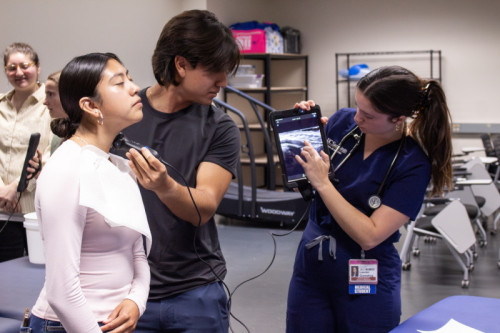
A common theme in medical education USA news is the push for early clinical exposure. Medical schools want applicants who understand the realities of patient care, not just the theoretical science behind it. At the NCAMP conference, students did not just listen to lectures; they actively engaged with clinical tools. Participants operated ultrasound machines, observed medical evaluations, and interacted with diagnostic equipment.
Newell noted that she did not touch an ultrasound until she arrived at medical school. By providing this exposure at the undergraduate level, conferences like NCAMP give students a tangible goal to work toward. Seeing the inside of a blood vessel or the structures of the eye turns abstract biology concepts into concrete medical realities. This hands-on experience accomplishes two things: it strengthens a student’s resolve to pursue medicine, and it provides compelling material for medical school secondary essays and interviews.
To replicate this experience, undergraduates should aggressively pursue clinical volunteering, medical scribing positions, or emergency medical technician (EMT) certifications. Submit your application today for local clinical volunteering programs to start building your practical skill set.
Why Students Conference News Highlights Peer Networking
Following students conference news reveals a recurring theme: peer networking is just as valuable as faculty mentorship. At NCAMP, Newell was joined by fellow CSUSM alumni Vince Adair and Austin Powell, both of whom are now medical students at UCSD. For current undergraduates, seeing individuals who sat in the exact same lecture halls and navigated the same campus resources successfully reach medical school is a powerful antidote to imposter syndrome.
Many pre-medical students falsely believe that medical students possess some innate, unteachable trait that separates them from the average undergraduate. Interacting with peer mentors breaks down this misconception. Medical students are regular people who simply executed a long-term plan with discipline. Forming study groups with other pre-med students, joining organizations like the American Medical Student Association (AMSA), and attending regional conferences allow you to build a network of peers who will eventually become your colleagues in the healthcare system.
Streamline the Transfer Process from Community College
The NCAMP conference specifically targeted students from CSUSM, Palomar College, and MiraCosta College, recognizing that the pathway to medical school often begins at a community college. Transfer students face unique challenges, including shortened timelines to build a GPA at a four-year institution, potential credit loss, and delayed integration into campus pre-med communities.
Conferences that include community college students provide vital information on articulation agreements, transfer timelines, and strategies for maintaining research continuity. If you are a community college student aiming for medical school, you must connect with the pre-medical advising office at your target four-year institution before you transfer. Understand exactly which courses will count toward your science GPA and identify research labs that accept transfer students.
Have questions? Write to us! We can help clarify the transfer process and connect you with the right academic advisors for your pre-medical track.
Apply These Strategies to Your Medical Education Journey
Reading about successful conferences is only beneficial if you apply the underlying strategies to your own life. The core takeaways from the CSUSM NCAMP event can be implemented by any aspiring medical professionals USA, regardless of their geographic location or institution.
First, audit your current mentorship relationships. Are you having substantive conversations with faculty, or are your interactions purely transactional? Second, evaluate your clinical exposure. If your only clinical experience is shadowing a physician for a few hours, you need to seek deeper, more hands-on roles. Third, look at your peer network. Are you surrounded by students who challenge you academically and support you emotionally?
Regional pipeline programs and pre-medical conferences exist across the country. Search for events hosted by your state’s medical schools, local health departments, or university pre-medical associations. Attend these events with specific questions prepared for the speakers and panelists.
Track USA Medical School News for Upcoming Opportunities
The medical school admissions landscape shifts frequently. Staying informed requires active effort. Regularly reading USA medical school news and updates from associations like the Association of American Medical Colleges (AAMC) ensures that you are aware of changes to the MCAT exam, shifting admissions requirements, and new pipeline programs.
The success of the North County Aspiring Medical Professionals Conference proves that local institutions are heavily invested in student success. Take advantage of these investments. Seek out your campus equivalents of the Center for Training, Research, and Educational Excellence at CSUSM. Find the offices dedicated to health professions advising. The resources are available, but they require you to take the initiative to access them.
Explore our related articles for further reading on building a competitive medical school application from any academic starting point.