Navigate a Career in Global Sport Management: Pacific University Alumna at the FIFA World Cup
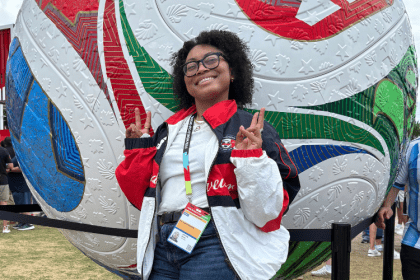
Recent news surrounding the 2026 FIFA World Cup in the USA has brought the massive scale of international sporting events to the forefront of the sports industry. Behind the millions of fans, athletes, and broadcast crews is a complex network of professionals managing logistics, hospitality, and corporate partnerships. Ifla Hayes ’19, a University of the Pacific graduate, recently served on the front lines of this operation. Her experience provides a clear, detailed look at what it takes to build a career in global sport management and how targeted academic programs can prepare professionals for the highest levels of the industry.
Understanding the Scope of Sport Management at the FIFA World Cup
Working at the FIFA World Cup extends far beyond the boundaries of the soccer pitch. For corporate partners, the event represents a significant investment in hospitality, client retention, and brand visibility. Managing these experiences requires precise coordination across multiple host cities, including New York, Dallas, Miami, and Atlanta. As an account manager with Octagon, a global sports marketing agency, Hayes was tasked with ensuring that these high-stakes corporate experiences ran without a hitch.
Her specific role involved working with the ABInBev Global team to manage comprehensive guest itineraries. This included coordinating intercity travel for guests attending matches in different locations, managing office operations, and overseeing guest hosting duties. A major component of this logistics work involved providing guests with Visa Prepaid cards to cover food, beverage, and leisure expenses during their free days in host cities across the USA. This level of operational detail highlights a critical reality in sport management: success is often measured by how seamlessly the background logistics are handled, completely invisible to the end user.
Have questions about what sport management entails? Write to us!
Building the Foundation for a Global Sports Career
Reaching the level of managing corporate hospitality at the FIFA World Cup does not happen overnight. It requires a foundation built on diverse experiences and a willingness to seek out opportunities. According to Associate Professor of Sport Management Pete Schroeder, the Pacific University sport management program is intentionally designed to expose students to a wide variety of careers within the sports industry. The goal is to help students build robust resumes through experiential learning, both inside and outside the classroom.
Hayes exemplified this approach during her time as a student. By actively participating in volunteer opportunities, securing internships, and studying abroad, she gathered a comprehensive skill set that translated directly to her professional life. Faculty members at Pacific University focus on presenting different approaches to current issues in sports, which helps students develop the confidence required to enter a highly competitive field. More importantly, this academic environment fosters the nimbleness needed to adapt as professionals grow in their careers.
The Value of Experiential Learning
The transition from a classroom environment to a high-pressure global event relies heavily on prior hands-on experience. Experiential learning allows students to test their theoretical knowledge in practical settings, exposing them to the unpredictable nature of live events. Whether it is managing a local collegiate sporting event or assisting with a regional corporate sponsorship, these experiences teach students how to communicate effectively under pressure, manage stakeholder expectations, and solve logistical problems in real time. These are the exact skills that hiring managers look for when selecting staff for marquee events like the FIFA World Cup.
Submit your application today to start building your foundation in sport management.
Essential Skills for Major Sporting Events
Operating at the highest levels of the sports industry demands a specific set of professional skills. Hayes identified two primary capabilities that proved essential during her time at the World Cup: flexibility and a solution-oriented mindset.
Maintaining Flexibility Under Pressure
In event logistics, contingency planning is standard practice. However, there comes a point in any major global event where every contingency plan has been exhausted, and professionals must adapt on the fly. Hayes noted that being flexible and knowing when to pivot, especially while onsite, is a major learning curve for detail-oriented planners. The ability to abandon a failing plan without panic, assess the immediate situation, and chart a new course is what separates competent managers from exceptional ones. In the fast-paced environment of the FIFA World Cup, rigid adherence to a plan is often less valuable than the agility to change direction when variables shift.
Adopting a Solution-Oriented Mindset
Closely tied to flexibility is the necessity of bringing solutions rather than just identifying problems. In high-stress environments, pointing out an issue without proposing a way forward can stall operations and frustrate team dynamics. The academic training at Pacific University emphasizes creative thinking and solution-oriented problem solving. When a crisis occurs—such as a sudden flight cancellation between two USA host cities or a last-minute change in guest requirements—professionals must approach their leadership team with actionable alternatives. This proactive approach builds trust with supervisors and establishes a professional reputation as a reliable problem solver.
Schedule a free consultation to learn more about developing these essential skills.
Actionable Advice for Aspiring Sports Professionals
For current students and recent graduates aiming for a similar career path, the trajectory from a university program to the FIFA World Cup provides several concrete, actionable lessons.
Volunteer for Every Task
Hayes’s path to the FIFA World Cup was directly paved by her performance at the 2024 Paris Olympics. During that event, she focused on executing her assigned duties flawlessly while simultaneously volunteering for any additional tasks that arose. This willingness to take on extra work did not go unnoticed. The director leading the ABInBev Global team remembered her work ethic and specifically reached out to her line manager to request her for the 2026 FIFA World Cup. In the sports industry, reputation is built on reliability. Doing the unglamorous work with a positive attitude often leads directly to the most prestigious assignments.
Communicate Your Career Goals Clearly
Ambition in the workplace must be paired with clear communication. Early in her tenure at Octagon, Hayes explicitly told her line manager that her goal was to work on the global side of the business. This transparency allowed her manager to act as an advocate, putting her name forward for international opportunities like the Women’s Rugby World Cup in London and ultimately the FIFA World Cup in the USA. Managers cannot advocate for goals they do not know exist. Making these professional connections and clearly stating your objectives is instrumental, as leadership often has access to opportunities and networks that entry-level employees cannot reach on their own.
Capitalize on Every Opportunity
Building a career in sport management requires a long-term perspective. Each internship, volunteer shift, and entry-level role is a stepping stone. As Schroeder pointed out, Hayes took her diverse experiences and blazed her own trail by capitalizing on every opportunity presented to her at Octagon. Aspiring professionals must view their early careers as a time to gather diverse skills, build a network of contacts, and establish a track record of excellence. The combination of these elements creates the professional capital required to be selected for marquee global events.
Share your experiences in the comments below!
Taking the Next Step in Sport Management
The intersection of global sports and corporate hospitality offers a demanding but highly rewarding career path for those with the right preparation. The recent news of Pacific University alumni working behind the scenes at the FIFA World Cup in the USA serves as a practical case study for what is possible. It demonstrates that success in this field requires more than a passion for sports; it requires rigorous training in logistics, a commitment to experiential learning, and the development of a flexible, solution-oriented professional mindset.
For students willing to put in the work, volunteer for extra responsibilities, and clearly communicate their career aspirations, the opportunity to work on the world’s biggest stages is an achievable reality. The sport management program at Pacific University continues to prepare students for these exact scenarios, providing the academic framework and practical experiences necessary to enter the field with confidence and adapt as the industry evolves.
Explore our related articles for further reading on careers in the sports industry.