Examine the History of the First Medical School in the Western USA at University of the Pacific
Tracing the Roots of Medical Education in the Western United States
Understanding the development of medical education in the United States requires looking beyond the well-established institutions of the East Coast. In the mid-19th century, as the nation expanded westward, the demand for formally trained physicians grew exponentially. Establishing standardized medical training in these new territories was a critical step in ensuring public health and safety. At the forefront of this expansion was the University of the Pacific, which played a foundational role in shaping healthcare education on the West Coast. By examining this history, prospective students and healthcare professionals can better appreciate how regional medical training evolved to meet the needs of a growing population.
Schedule a free consultation to learn more about how historical contexts shape modern medical education.
The 1858 Founding of Pacific’s Medical Department
Less than a decade after the University of the Pacific was founded in 1851 as California’s first chartered college, the institution recognized a critical gap in regional infrastructure. In 1858, the university established its “Medical Department” in San Francisco. At that time, the entire United States hosted fewer than 50 medical schools, and remarkably, none existed west of Missouri. Pacific’s initiative effectively created the first medical school in the Western USA.
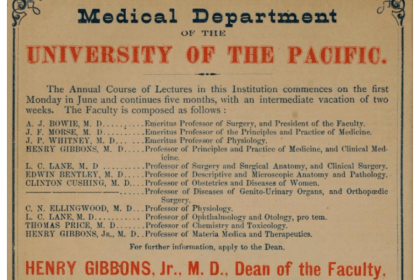
The inaugural class was intimate yet impactful, consisting of just four faculty members and 13 students. Despite these modest beginnings, the program successfully graduated 44 physicians. The curriculum and clinical exposure provided by this early medical school helped to professionalize healthcare in a region that was still largely defined by its frontier status. Historical records, including an 1858 advertisement for the program, highlight the institution’s early commitment to structured medical education.
Geographic Reach and Early Student Demographics
While the Medical Department was located in San Francisco, its appeal extended far beyond the city limits. The program attracted future physicians from neighboring states such as Nevada and Oregon, as well as from the broader Midwest. International students from as far away as Japan and Australia also traveled to California to study medicine at Pacific. This diverse student body demonstrated early on that the university’s medical program was addressing a widespread, unmet need for advanced medical education across the Pacific Rim and the American West.
The Transition to Cooper Medical School and Stanford
Like many 19th-century institutions, Pacific’s Medical Department eventually underwent significant structural changes. The medical school separated from the university to become an independent entity known as Cooper Medical School. This transition reflected the shifting landscape of medical education, where independent medical colleges often sought separate governance and funding to expand their clinical facilities and teaching hospitals.
In 1908, Stanford University purchased Cooper Medical School to establish its own medical department. This acquisition laid the groundwork for what is known today as the Stanford University School of Medicine. Therefore, the lineage of the first medical school in the West directly flows into one of the most prestigious medical institutions in the modern United States. This historical footnote underscores the high quality and foundational importance of the education originally provided by University of the Pacific.
Mid-Century Efforts to Restore Medical Education at Pacific
Following the departure of the original Medical Department, University of the Pacific maintained its focus on liberal arts and other professional disciplines. However, the ambition to re-enter the medical education space never fully disappeared. According to former Provost Philip N. Gilbertson’s book, “Pacific on the Rise,” serious discussions about reinstating a medical school resurfaced in the early 1960s under the leadership of President Robert E. Burns.
Partnerships in San Francisco and Sacramento
President Burns took concrete steps to rebuild the university’s medical education capacity. In 1962, Pacific formed a strategic partnership with the Institute of Medical Sciences in San Francisco. The institute required a university affiliation to grant medical degrees, a credential Pacific was able to provide by establishing a “Graduate School of Medical Sciences.”
Simultaneously, the university’s Board of Regents approved the creation of a “School of Medical Technology” in partnership with Sutter Community Hospitals in Sacramento. This program required students to complete three years of academic coursework at Pacific, followed by one year of hands-on clinical training at Sutter. Although this specific partnership concluded in 1968, it reinforced Pacific’s ongoing commitment to producing highly trained healthcare professionals equipped to serve diverse communities.
Addressing the Modern Physician Shortage in the Central Valley
Today, the necessity for a new medical school in Northern California is driven by a severe and escalating public health crisis. California’s Central Valley faces a profound physician shortage. The region’s rapidly growing, diverse population lacks adequate access to primary care and specialized medical services. Extensive research in healthcare workforce dynamics indicates a clear trend: physicians are significantly more likely to establish their practices in the geographic regions where they complete their medical education and residency training.
By training doctors locally, universities can directly mitigate regional shortages. Students who engage in community-based learning during their education develop ties to the local healthcare infrastructure and patient populations. This retention effect is a primary strategy for addressing healthcare deserts, making the establishment of new regional medical schools a critical public health intervention.
The Strategic Opening of the New School of Medicine in 2030
Recognizing this urgent need, University of the Pacific is now returning to its medical school roots. Under the leadership of President Christopher Callahan, the Board of Regents voted in May to approve the establishment of a new School of Medicine. The university plans to open the School of Medicine in 2030, a timeline that is contingent upon securing the necessary accreditation approvals from national medical education governing bodies.
“As the first and oldest university in California, Pacific is rooted in a legacy of opportunity and innovation,” President Callahan stated. “The School of Medicine will build on our long-standing strengths in health care education while serving our communities, which is a core tenet of who we are as Pacificans.”
Submit your application today to express your interest in joining the future of healthcare education in California.
Building on a Strong Foundation of Health Sciences
The planned School of Medicine will not be an isolated endeavor. It is designed to expand upon University of the Pacific’s extensive, existing infrastructure for health sciences education. The university already operates highly respected programs that produce thousands of healthcare professionals annually. These include the Arthur A. Dugoni School of Dentistry, the Thomas J. Long School of Pharmacy, and the comprehensive School of Health Sciences.
Integrating a medical school into this existing ecosystem offers distinct advantages. Interprofessional education—where medical students learn alongside dental, pharmacy, and health sciences students—mirrors the collaborative nature of modern healthcare teams. This approach ensures that graduates are not only clinically proficient but also adept at functioning within complex, multidisciplinary healthcare systems. Furthermore, the university recently announced a clinical partnership with Dignity Health St. Joseph’s Medical Center, which will provide essential clinical training grounds for future medical students.
The Cyclical Nature of Medical Education History
The trajectory of medical education at University of the Pacific illustrates a fascinating historical cycle. From the pioneering days of 1858, when a small faculty educated the first western-trained physicians, to the mid-century partnerships that kept the medical vision alive, the institution has consistently identified and responded to societal health needs. Now, over 170 years after those first 13 students enrolled in San Francisco, the university is preparing to scale its impact dramatically.
The establishment of the School of Medicine represents a strategic alignment of historical legacy and contemporary necessity. For prospective medical students, this development offers a unique opportunity to be part of a founding class that carries forward a tradition of regional medical firsts. It provides a chance to study in an environment that explicitly values community impact, historical awareness, and interprofessional collaboration.
As the accreditation process moves forward and the 2030 opening date approaches, the narrative of medical education in the West continues to evolve. University of the Pacific’s re-entry into medical training is poised to shape the healthcare landscape of the Central Valley for generations to come, proving that understanding institutional history is vital for planning future healthcare infrastructure.
Share your experiences in the comments below regarding the impact of regional medical schools on community health.
Explore our related articles for further reading on the evolution of healthcare education in the United States.