Review How Pacific University Graphic Design Students Earned a Gold Award in the USA
Understand the Impact of Real-World Client Projects in Graphic Design Programs
Recent graphic design news from the USA highlights a significant achievement by University of the Pacific students who earned a prestigious international award. This recognition stems not from a theoretical assignment, but from a comprehensive advertising campaign developed for a real-world client. For aspiring designers and educators, this accomplishment serves as a compelling case study in the value of experiential learning.
Traditional classroom environments often rely on hypothetical scenarios to teach design principles. While these exercises build foundational skills, they frequently lack the nuanced challenges that arise when working with actual businesses. Real clients have specific brand guidelines, budget constraints, target demographics, and practical implementation requirements. When graphic design students engage directly with local businesses, they must navigate these realities, ultimately producing a more robust and tested portfolio.
The Pacific University project demonstrates how integrating local business partnerships into the curriculum bridges the gap between academic theory and professional practice. By taking on a client like Groundstack Coffee, located on Stockton’s Miracle Mile, students were forced to consider factors such as foot traffic, customer engagement in a physical space, and how digital elements interact with physical packaging. This approach to education ensures that graduates are not just technically proficient, but also professionally adaptable.
Schedule a free consultation to learn more about how experiential learning can shape your design career.
Analyze the Groundstack Coffee Augmented Reality Campaign
The core of the award-winning project was an immersive, multi-channel advertising campaign that integrated augmented reality (AR) technology with traditional branding. Students in the Arts 77: Branding and Identity Systems class were tasked with creating seasonal advertisements that maintained a cohesive visual identity while utilizing AR to enhance the customer experience.
Integrating Seasonal Branding with Interactive Technology
The students developed two distinct seasonal campaigns: one for Halloween and one for Christmas. Seasonal branding requires a delicate balance. Designers must alter the visual language to reflect the mood of the holiday—using darker, spookier color palettes for Halloween, and warmer, more vibrant tones for Christmas—while ensuring the core brand identity of Groundstack Coffee remains instantly recognizable.
To achieve this, the students likely had to establish strict brand parameters early in the process. They defined the non-negotiable elements of the Groundstack brand, such as specific logo usage, primary typography, and core brand colors. From there, they created flexible design systems that could accommodate seasonal variation without causing brand dilution. This type of systematic thinking is exactly what hiring managers look for in junior graphic designers.
The Technical Execution of QR Code Animations
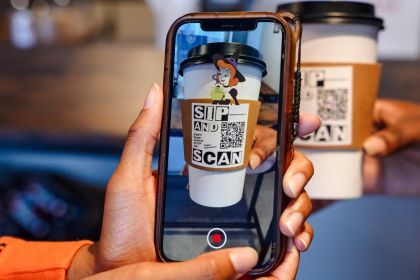
The interactive component of the campaign relied on QR codes placed on the coffee shop’s physical cups. When customers scanned these codes with their smartphones, they unlocked digital animations that brought the holiday themes to life. This execution highlights a growing trend in graphic design where physical and digital spaces converge.
From a technical standpoint, the students had to ensure that the transition from the physical cup to the digital animation was seamless. The QR code placement had to be intuitive, and the resulting animation had to load quickly and function across a variety of mobile devices. Furthermore, the animation itself needed to be visually connected to the printed cup design, creating a unified narrative rather than a disjointed experience. This requires proficiency in both print design and digital motion graphics, illustrating the modern demand for multi-disciplinary designers.
Submit your application today to start building your multi-disciplinary design skills.
Recognize the Value of International Design Competitions in the USA
The Pacific University students received a Gold Award from the Horizon Interactive Awards in the Multi-Channel Advertising category. Understanding the weight of this award requires a closer look at the landscape of design competitions within the USA and internationally.
What the Horizon Interactive Awards Evaluate
The Horizon Interactive Awards is an international competition that recognizes excellence in digital, interactive, video, and emerging media. It attracts submissions from large global agencies, renowned design studios, and educational institutions. When a university graphic design program wins gold in this arena, it signifies that the student work is not just good for an academic setting—it is competitive on a global, professional scale.
Judging in such competitions typically focuses on several key areas: creative concept, visual appeal, technical execution, usability, and overall effectiveness. For the Pacific University students, winning gold indicates that their AR campaign excelled in integrating an engaging creative concept with flawless technical execution. It proves that their use of augmented reality was not merely a gimmick, but a purposeful tool used to enhance brand storytelling and customer engagement. For prospective students evaluating graphic design programs, the presence of such awards is a strong indicator of a program’s ability to prepare students for high-level industry standards.
Have questions? Write to us! to discuss the value of design competitions in your education.
Apply Lessons from Award-Winning Student Work to Your Own Portfolio
Whether you are a current student or a self-taught designer looking to break into the industry, the success of the Pacific University graphic design cohort offers actionable lessons you can apply to your own work.
- Seek Out Real-World Opportunities: Hypothetical projects have their place, but your portfolio will stand out if it contains work created for actual clients. Approach local small businesses—like a neighborhood coffee shop or a local boutique—and offer to redesign a menu, create social media assets, or develop a small branding package. The constraints of a real client will force you to improve your problem-solving skills.
- Embrace Emerging Technologies: Augmented reality, 3D design, and interactive media are no longer niche specialties; they are becoming standard expectations in many sectors of the advertising industry. Familiarize yourself with accessible AR platforms and experiment with how traditional print design can serve as a gateway to digital experiences.
- Focus on Multi-Channel Cohesion: Do not design in a vacuum. When you create a logo, immediately think about how it will look on a website, a social media profile, a printed flyer, and a physical product. The Horizon Interactive Award specifically recognized the multi-channel nature of the Pacific students’ work. Demonstrate in your portfolio that you understand how to maintain brand consistency across various mediums.
- Document Your Process: Awards and hiring managers alike want to see how you arrived at your final solution. Include case studies in your portfolio that detail your research, conceptual sketches, client feedback, and iterative design processes. This provides context to your final visuals and proves your strategic thinking capabilities.
Build a Foundation for Success in Graphic Design at Pacific University
The achievement of these Pacific University students is a direct reflection of the pedagogical approach within the Department of Art, Media, Performance, and Design. Assistant Professor Zoya Laskowski guided the students through the Arts 77: Branding and Identity Systems class, emphasizing the importance of faculty-student collaboration.
Student feedback from the project reinforces the idea that rigorous, client-based projects build confidence. Nevaeh Padilla, an art major with a concentration in graphic design, noted that working with a local coffee shop allowed the class to develop practical skills directly applicable to their futures. Similarly, Ashley Brown, a psychology major with a minor in graphic design, highlighted how targeted faculty support made complex, intimidating projects feel achievable.
This news from Pacific University underscores a critical reality for aspiring designers: the quality of your education is heavily influenced by the opportunities you have to apply your learning. Programs that prioritize real-world application, integrate modern technologies like AR, and support students through international competition submissions provide a distinct advantage in the competitive USA job market.
Share your experiences in the comments below regarding your own client-based design projects.
Explore our related articles for further reading on how to leverage university resources for your design career.