How UNE Students Use Creative Meal Kit Recipes to Fight Food Insecurity in the USA
Food insecurity remains one of the most persistent public health challenges in the USA, affecting families in every state — including those in rural communities and college towns that might not appear vulnerable at first glance. Addressing it requires more than donations and good intentions. It requires practical knowledge: knowing how to convert shelf-stable staples into meals that are nutritious, affordable, and genuinely appealing.
The University of New England (UNE) recently demonstrated what that kind of practical education looks like. At its Biddeford Campus Teaching Kitchen, students learned to take basic meal kits and adapt them into multiple balanced dishes — a skill with direct implications for the families these kits ultimately reach. The session served as the on-ramp to Meals for Maine, the university’s large-scale meal-packing initiative.
This article examines what took place at UNE, why meal kits have become such a valuable tool in hunger relief, and how students, educators, and community organizations can apply the same approach in their own communities. If you work in nutrition, public health, education, or volunteer services, the model described here is worth studying closely. Have questions about how programs like this come together? Reach out to the organizations mentioned — most welcome inquiries from people eager to help.
A Hands-On Look at Food Insecurity Solutions at UNE
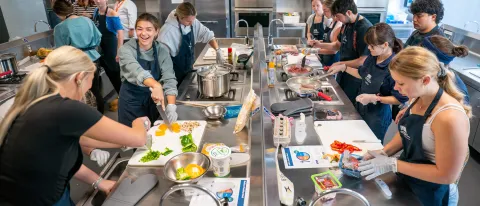
On September 8, UNE welcomed Don Morrison, operations manager for Wayside Food Programs, to lead a culinary demonstration in the Biddeford Campus Teaching Kitchen. Rather than lecturing about hunger statistics, Morrison put students to work with the very ingredients that food pantries distribute every day.
The centerpiece of the demonstration was a simple red beans and rice kit — the same kit students would later help assemble by the tens of thousands. Morrison prepared two distinct recipes using that single base, supplementing it with ingredients commonly found on food pantry shelves. The lesson was immediate and concrete: the same box of ingredients can become two entirely different dinners with modest additions and different techniques.
Students then broke into teams to replicate and adapt the recipes themselves. This team-based format was not incidental. Cooking alongside peers builds confidence far more effectively than passive observation, and it mirrors how cooking knowledge actually spreads within communities — through shared practice rather than pamphlets.
For students in nutrition, health sciences, and public health programs, the session offered something a classroom cannot: direct exposure to the real constraints families face, including limited ingredients, limited equipment, and limited time. Understanding those constraints is essential for anyone who hopes to design effective food assistance programs.
Why Meal Kits Are a Practical Tool Against Hunger
Meal kits occupy a useful middle ground in food distribution. They are not as perishable as fresh produce, but they are more structured than a random assortment of canned goods. That structure delivers several advantages for organizations working to reduce food insecurity.
Consistency and Planning
Because every kit contains a defined set of ingredients, families know exactly what they are receiving, and food programs can plan production at scale. There is no guesswork about whether a recipe will come together — the components are guaranteed to match.
Efficient Assembly
Standardized kits lend themselves to volunteer-driven assembly lines. This is precisely why a university can mobilize hundreds of volunteers to produce hundreds of thousands of meals in a single day. Without standardization, that kind of output would be logistically impossible.
A Foundation for Creative Recipes
Most importantly, a well-designed meal kit is a starting point rather than a ceiling. As the UNE demonstration showed, one kit can support multiple creative recipes. When organizations pair kits with simple recipe guidance, they give families both the ingredients and the inspiration to vary their meals — which matters enormously for anyone relying on pantry staples week after week.
If you are involved with a food pantry or community kitchen, consider auditing your distributions with these criteria in mind. Are your kits standardized enough for efficient assembly? Do they come with suggestions for variation? Small changes in packaging and documentation can meaningfully improve the experience of the families you serve. Share your own experiences with kit-based distribution in the comments below — practitioners learn a great deal from one another.
Creative Recipes: Stretching Simple Ingredients Into Balanced Meals
The most instructive moment in the UNE demonstration was also the simplest: two recipes, one kit. This principle deserves unpacking, because it applies to nearly any shelf-stable base.
Red beans and rice is already a nutritionally sound combination — together, beans and rice form a complete protein, providing essential amino acids that neither supplies alone. From that foundation, a cook can move in several directions depending on what the pantry offers:
- Adding canned tomatoes and peppers shifts the dish toward a heartier stew with additional vitamins and fiber.
- Changing the seasoning profile — for example, adding cumin and garlic versus thyme and paprika — produces noticeably different meals without meaningfully changing cost.
- Stretching the base with extra rice or inexpensive vegetables increases the number of servings a single kit provides, which directly matters for larger households.
None of these techniques require culinary training. They require only exposure and practice — exactly what the Teaching Kitchen session provided. Nutrition educators have long observed that people do not adopt healthier eating patterns because of information alone; they adopt them when they gain the hands-on confidence to prepare food that tastes good. Demonstrations like this one close that gap.
Meals for Maine: Scaling Student Service Across 16 Counties
The teaching kitchen event was the prelude to a much larger effort. On September 16, UNE’s Meals for Maine initiative brought together more than 500 volunteers across the university’s Biddeford and Portland campuses to assemble 200,000 meals for distribution across all 16 of Maine’s counties.
The scale is worth appreciating. Two hundred thousand meals represents a substantial contribution to a state where rural geography complicates food distribution — many households live far from the nearest full-service grocery store, making shelf-stable kits especially valuable. Distributing across all 16 counties ensures that both urban and remote communities receive support.
Just as significant is what the demonstration added to the volunteer experience. Students who packed meals after having cooked those same meals themselves understood, in a tangible way, what their work would become in someone’s kitchen. That connection converts a volunteer shift into a form of applied education in nutrition and community health. For students considering careers in dietetics, medicine, or public health, early exposure to food access issues shapes how they will practice for decades.
Are you a student looking for service opportunities that build professional skills? Programs like Meals for Maine exist at many institutions, and where they do not, student organizations have often been the ones to start them. Ask your student affairs office or nutrition department what food security initiatives operate on your campus — and if the answer is none, propose one. Explore UNE’s nutrition and health professions programs to see how academic coursework and community service are integrated.
What Students Take Away: Skills That Outlast the Event
Participants in the UNE demonstration gained more than a few recipes. The session reinforced several competencies with lasting value:
- Resourcefulness: the ability to assess available ingredients and produce a satisfying meal regardless of circumstances.
- Nutrition literacy: practical understanding of how complementary foods — like beans and rice — combine to meet dietary needs.
- Empathy grounded in experience: firsthand familiarity with the realities of pantry-based cooking, which counteracts abstract assumptions about hunger.
- Teamwork under real conditions: coordinating a shared cooking task builds collaboration skills transferable to clinical and community settings.
These outcomes explain why service learning has become a staple of health professions education. The students who cooked together that afternoon were not merely filling volunteer hours; they were rehearsing the community-facing dimensions of their future professions.
How Other Communities Can Apply This Model
The encouraging news is that UNE’s approach is replicable at almost any scale. A single classroom, a church group, or a workplace volunteer committee can adapt it. The core steps are straightforward:
- Partner with an experienced food program. Organizations like Wayside Food Programs understand pantry supply chains and know which ingredients families actually receive. Their staff make excellent instructors.
- Secure an accessible kitchen. School teaching kitchens, church halls, and community centers frequently make their facilities available for educational programming.
- Build the session around real ingredients. Design the demonstration using the same kits and staples that local distribution provides, so participants learn with authentic constraints.
- Have participants cook, not just watch. Active preparation is where confidence forms.
- Document and share recipes. Simple recipe cards distributed alongside meal kits extend the lesson to every household that receives one.
Communities across the USA — from small towns to large metros — have used variations of this model to strengthen local food security. The investment required is modest; the coordination required is real but manageable; and the payoff is measured in both meals served and skills transferred. Explore our related articles on community nutrition and volunteer program design for further reading.
Turning Awareness Into Action on Food Insecurity
The UNE event demonstrates that meaningful progress against food insecurity often begins with something as humble as a red beans and rice kit and a group of willing students. Creativity, applied through basic cooking knowledge, multiplies the value of every dollar and every donated hour that hunger relief programs receive.
If this model resonates with you, take a concrete next step this month: volunteer with a local food program, propose a teaching kitchen session at a school or community center near you, or simply add a few recipe cards to your next food donation. If you are considering a degree that combines nutrition science with hands-on community service, request more information about programs like UNE’s or schedule a visit to see the Teaching Kitchen approach in person. And if you have organized a similar initiative in your own community, write to us or share your story — practical examples like yours are how these ideas spread.